

Every April, National Dog Bite Prevention Week serves as a critical reminder of just how serious and widespread dog attacks are across the United States. The numbers for 2024 and 2025 paint a deeply troubling picture. With dog ownership at an all-time high, approximately 89.7 million dogs living in U.S. households, the risk of being bitten has never been greater.
This post outlines the national dog bite statistics, explains how to prevent a serious dog attack, and explores what you should do if you or a loved one suffers dog attack injuries.
Proactive Dog Attack Prevention Can Save Lives
Preventing a dog attack is always preferable to navigating the physical, emotional, and legal aftermath of a bite. Most bites are entirely preventable when we understand canine body language and respect an animal’s personal space.
Prevention requires a multi-layered approach, from how we manage our pets at home to our conduct in public and the workplace.
Preventing Dog Bites in the Home
By teaching children how to interact with dogs and taking necessary precautions in your daily routines, you can dramatically reduce the risk of severe injury. Since most child dog bites occur at home with a familiar dog, establishing strict household rules is the best line of defense.
- Enforce Active Supervision: Never leave an infant or young child unsupervised with a dog, regardless of the dog’s breed or past behavior. If you cannot actively watch them, physically separate the child and the dog.
- Respect the Dog’s Boundaries: Teach children they shouldn’t approach a dog that is sleeping, eating, or chewing on a toy. Startling a resting dog or threatening their resources are two of the most common triggers for a defensive bite.
- Create a Safe Zone: Ensure the dog has a designated space, such as a crate, bed, or separate room, where they can retreat when overwhelmed. Make it a strict household rule that children are not allowed to bother the dog in their safe zone.
- Teach Gentle Interaction: Show children how to pet a dog gently on the back or chest. Discourage them from pulling ears, riding the dog, or hugging and kissing the dog’s face, as dogs often interpret face-to-face contact as a threat.
Preventing Dog Bites at Work
For postal workers, delivery drivers, and utility personnel, entering unfamiliar properties carries inherent risks.
- Assess the Environment
Before exiting your vehicle or opening a gate, look for signs of a dog on the property, such as worn paths in the grass, food bowls, chew toys, or “Beware of Dog” signs.
- Announce Your Presence
Never surprise a dog. Rattle the fence or call out to alert any dogs that you are entering their territory.
- Use a Barrier
If an aggressive dog approaches, do not turn your back or run. Instead, place an object, like a clipboard, package, or umbrella, between yourself and the dog to block their access to your body.
- Never Assume a Dog is Friendly
A wagging tail does not always mean a dog is happy. It may simply mean the dog is highly stimulated. Treat all unknown dogs with caution and maintain a safe distance.
Preventing Child Dog Bites in Public Settings
Whether at a park or walking down the street, public settings introduce unpredictable variables. Education is key to keeping both adults and children safe.
- Always Ask Permission: Teach children the golden rule of public dog interactions: They must ask both the dog owner and you for permission before approaching any unfamiliar dog.
- Let the Dog Come to You: If the owner says yes, tell your child to let the dog approach them. Offer a closed fist for the dog to sniff, and avoid reaching over the dog’s head, which can feel intimidating.
- Avoid Territorial Zones: Teach children they should never reach through a fence to pet a dog, or into a parked car. Dogs are highly protective of these confined spaces and are much more likely to bite an intruding hand.
- Play “Be a Tree”: If a loose or aggressive dog approaches, teach children to stop moving, tuck their arms in, look down, and stay completely quiet. Running or screaming triggers a dog’s prey drive and encourages them to chase.
The Scale of Dog Attacks in the U.S.
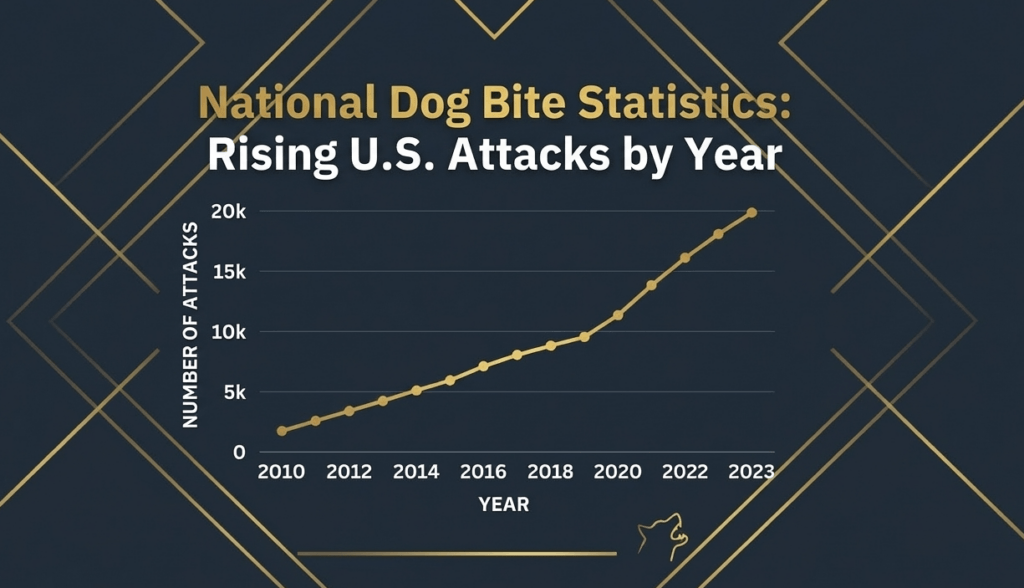
In addition to proactive prevention, exploring the sheer number of dog attacks can help you recognize the potential danger. Dog bites are becoming far more common year-on-year, according to the most recent data. With the increasing frequency of attacks, the financial and physical toll continues to climb.
- Dogs bite approximately 4.5 million Americans annually, equating to roughly one bite every seven seconds.
- Close to 885,000 victims seek medical care for dog bites each year, with nearly 370,000 requiring emergency room treatment.
- The latest data show U.S. insurers paid out a record-breaking $1.57 billion across 22,658 dog-related injury claims. The average payout surged 18% to $69,272. Over the past decade, the average cost per claim has risen by nearly 87% due to higher medical costs and larger jury awards.
- Preliminary reports indicate there were more than 70 dog bite fatalities in 2025 (a 174% increase from five years prior).
- California, Florida, and Texas consistently report the highest dog bite claim volumes and fatalities. New York reports the costliest claims, averaging $110,488 per incident, reflecting the severity of urban attacks.
Dog Bites and Children
| Risk Factor | Details Behind the Risk of Child Dog Bites |
| High-Risk Age Group | Roughly 50% of all bite victims are children, with ages 5–9 being the most frequently bitten. Children under 5 and adults over 65 face the highest risk of fatality. |
| Severity of Injuries | Unlike adults, children are typically bitten in the head, face, and neck, which can lead to life-altering disfigurement or death. Infants under one year old made up nearly half of the youngest fatality victims between 2010 and 2023. |
| Familiar Dogs | Most child dog bites happen at home and involve a familiar dog. Children often unknowingly trigger defensive reactions during a dog’s rest, meals, or playtime, making parental supervision critical. |
| Legal Protections | Injury claims on behalf of minors follow special rules. In many states, young children cannot be found legally at fault for provoking a dog, which gives their claims greater legal weight. |
The Latest Research on Dog Bites at Work
Dog attacks are a serious workplace hazard, not just a neighborhood issue.
- Postal Workers: In 2024, more than 6,000 U.S. Postal Service employees were attacked by dogs on the job. The USPS dedicates an annual awareness campaign to this issue, aligning closely with April’s prevention efforts.
- Food delivery drivers, utility workers, and meter readers face similar risks when entering private property.
- Injured workers may have multiple avenues for financial recovery, including standard workers’ compensation and a direct personal injury claim against a negligent dog owner.
Rising Trends in Dog Bite Claims
Attorneys are noting a shift in the profile of dog bite claims, moving beyond traditional one-on-one bites.
- Pack Attacks: Multi-dog attacks rose 93% from 2019 and now account for 29% of all fatal incidents, raising complex liability questions among multiple owners.
- Off-Property Attacks: Incidents occurring outside a dog’s home territory rose 65% from 2019 to 2023, often implicating property managers or businesses that allow dangerous animals on their premises.
- Emotional Distress: Courts increasingly recognize post-traumatic stress, phobias, and ongoing psychological harm as compensable damages, especially for children or those suffering severe disfigurement.
6 Steps to File a Dog Bite Claim
If you or a loved one has been attacked, immediate action is vital for both your health and your legal claim.
- Seek medical attention right away: The CDC estimates that nearly 1 in 5 dog bites becomes infected. Immediate medical records are also essential evidence.
- Report the attack: File a formal report with local animal control or law enforcement to document the incident and the animal’s history.
- Document everything: Photograph your injuries over multiple days, capture the scene, gather witness info, and save all medical bills and records of lost wages.
- Identify the owner and insurance: Most claims are filed against the owner’s homeowners or renters insurance (typically covering $100,000 to $300,000).
- Understand your state’s law: Liability laws vary. Your state may follow “strict liability” (automatic responsibility), the “one-bite rule” (liability only if the owner knew the dog was dangerous), or negligence-based standards.
- Consult a dog bite injury attorney: Insurance companies work to minimize payouts. An experienced attorney will assess the value of your claim and handle negotiations, usually on a contingency-fee basis.
Frequently Asked Questions About Dog Bite Awareness and the Law
How long do I have to file a dog bite claim?
Statutes of limitations vary widely by state, from as little as one year (Tennessee) to three years (Mississippi, Arkansas). Do not wait. Consult an attorney as soon as possible after the attack.
What compensation can I recover?
Victims may recover economic damages (medical bills, lost wages, future care costs), non-economic damages (pain and suffering, disfigurement, emotional distress), and in severe cases, punitive damages.
What if the dog owner has no insurance?
If the owner is uninsured, you may be able to file a claim under your own insurance policy, pursue the owner personally through civil court, or explore whether a property owner or other third party shares liability.
Can I file a claim if a dog didn’t actually bite me but knocked me down?
Yes. Insurance claims and personal injury lawsuits cover all dog-related injuries, not just bites. Fractures from being knocked over are a common and recoverable category of harm.
What if a dog bites my child at someone else’s home?
Yes, you can file a claim. The attack taking place on private property does not shield the dog owner from liability, provided the victim was lawfully present. In many states, young children cannot be assigned comparative fault.
Attacked by a Dog? Book Your Free Dog Bite Case Review with Lawyer Jeff Penneys
Pennsylvania dog bite attorney Jeff Penneys helps local families navigate the often devastating aftermath of dog attacks. He has won millions of dollars in settlements and judgments through the courts. Don’t take on the burden of medical costs after a dog bite without exploring your legal options first. Schedule a meeting with Jeff Penneys today by calling (215) 259-3703 or booking your free consultation online. There are no fees unless you win compensation.